
Show Leadership Your Comms Worked Without the Dashboard

The quarterly review reaches internal comms, the slide of sends and open rates goes up, and a leader nods before asking some version of "so what?" Every other function in the room has brought its own numbers too, a pile Meaghan Baumwald, senior director of internal communications at XPO, called "a veritable number soup" at a Ragan measurement conference, as PR Daily reported.
To show leadership your comms worked, answer a question they already own with the few numbers that answer it. It takes four steps. Start from the business question, report who read the message by audience, set that read next to what changed, and close with the decision you need. Johnna Muscente, VP of communications and PR at Corcoran, told a Ragan session on comms dashboards that comms teams have "an insights problem." Each step below turns a number into an insight.
Reading the dashboard back won't show leadership your comms worked
A dashboard tells you what happened in your channels. The leader across the table wants to know whether the thing they care about moved. Muscente offers a thought experiment. Imagine a new platform's launch email hits a 90% open rate, and then a pulse survey shows fewer than half of employees understand what the launch changes for them. The channel looks healthy while the message has failed, and the dashboard would score it a win. Opens are a weak proxy for reading in any case, so the steps below count reads.
Rachel Miller of All Things IC names the habit behind this in a recent piece on proving value, where she describes the profession "measuring outputs, activity and channels, instead of outcomes and impact." Catherine Hernandez-Blades, a communications executive and independent board director, offered the fix in a talk Ragan wrote up as comms needing to bring its own chair to the table. Leadership wants one thing from those numbers, the "so what," she said, and "we would be much better off if we did the translation ourselves before we walked into that room." The four steps are that translation, done in advance.
Step 1: Start from the business question the leader owns
Name the result the leader is accountable for before you open a report. It might be a plant-safety change that has to land before the next shift, or benefits enrollment closing on a fixed date. Hernandez-Blades frames the starting point as two questions. What does the business need to achieve, and what do stakeholders have to "do, think, feel or believe" for communications to provide value?
Turn the answer into a one-line question card in the form "Did [audience] [know or do X] by [date]?" A hypothetical card to carry through the steps reads "Did site supervisors know the new lockout procedure before the 1 November shift change?" That line governs everything after it. Any number that doesn't help answer it stays out of the conversation, however good it looks.
Step 2: Report who received it and who read it, by audience
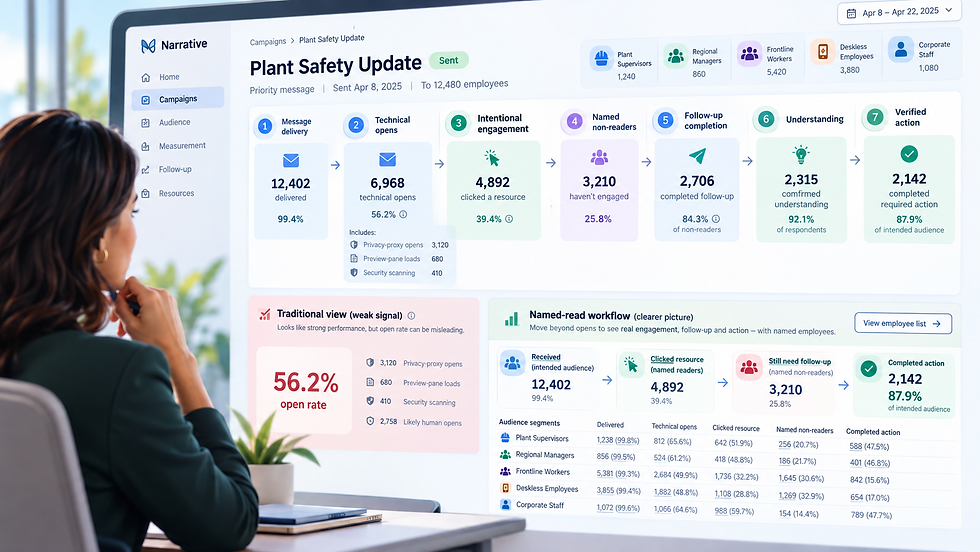
Bring delivered and read counts for the audience on the card, broken out the way the leader thinks about the business, by site or manager group. A single company-wide figure blends the audience this leader asked about with everyone else. A strong headquarters number can cover for a plant or a night shift where few people read the message, and that gap is the one the leader most needs to see.
Give reads as named counts. In the supervisor example, "212 of 240 site supervisors read it" lets the leader picture the 28 who didn't. The artifact is a small table of three to five rows, each showing delivered and read for one group, with the weakest row highlighted. If your send tool reports reads by audience segment, building it takes minutes.
Step 3: Connect read to what changed
Put the read number next to the outcome number for the same audience, and take the outcome from the system that owns it, HR for enrollment or operations for checklist completion. Keep it to one line about one audience. For the hypothetical supervisors, that line might read "212 of 240 read the change and 205 of those readers completed the checklist; the 28 who didn't read sit at two sites."
A read is the part you can attribute to a named person and to your work, since a supervisor has to read the procedure before acting on it. The outcome belongs to the business, and plenty besides your email shaped it. If you've already split readers from actors for your own analysis, this is where you surface the result, compressed into one sentence the leader can repeat. That sentence is the insight Muscente says comms teams lack, and it answers Miller's call to prove "the value it creates."
Step 4: Close with the decision you need
Baumwald's advice, as PR Daily reported it, was to bring fewer numbers, because "the fewer numbers that you can bring, the more narrative and call to action you can bring on those few KPIs." The supervisor example needs three, which leaves room for the part most comms updates skip, asking leadership to do something.
Attach a one-line ask to the gap row from Step 2, such as a manager nudge at the two quiet sites or a different channel for the night shift. That ask turns explaining internal communications metrics to leadership into a decision, and a leader who makes one has a reason to want the next update.
The three-minute version
With the hypothetical supervisor numbers, the conversation runs four sentences. "You wanted supervisors to know the new lockout procedure before the 1 November shift change. 212 of 240 have read it, and the gap sits at two sites. Of the supervisors who read it, 205 have completed the checklist in the ops system. I'd like the two site leads to raise it at their next huddle so we close the gap before the change goes live."
Keep the full dashboard to hand, and if someone asks about click-through or send timing, pull it up then. Leadership asked whether the thing worked. One question, one table, one line and one ask will answer it before the slide of open rates would have finished loading.


Comments