
Every Booth Says It Reaches Every Employee: Questions to Ask Internal Communications Vendors

This week IC teams from across the field head to Ragan's Internal Communications Conference, which runs October 13–15 on Microsoft's campus in Redmond. Walk the expo floor for ten minutes and count the banners promising to reach every employee. You will run out of fingers early. Reach is where every pitch starts, and the list of named employees who read the message is where most pitches stop.
The questions to ask internal communications vendors come down to four. Ask what counts as delivered, what counts as opened, how a read is produced for a named person, and what the badge on the booth measures. The same four work on the tool you already pay for.
"Reaches every employee" is a delivery claim
Practitioner Johnna Muscente, writing for Ragan, treats reach as the first of four measurement questions and notes that open rates are only the starting point. Reach is the first rung on a longer ladder.
Remember what "delivered" means in the systems underneath. In Microsoft's Exchange Online message trace documentation, a delivered status means the message was delivered to a mailbox. That is a transport fact about a server, and it says nothing about a human.
A vendor who says it reaches every employee owes you a denominator. Delivered to whom, and counted against what? If the platform measures against your HRIS headcount, you can compare the two numbers. If it measures against whatever distribution list it was handed, a perfect reach figure on a stale list says little about last month's hires or the frontline staff who never had a corporate inbox. Find out how deskless employees are counted inside "every," because they are often the ones the claim leaves out.
Ask what counts as an open, then ask what else they count
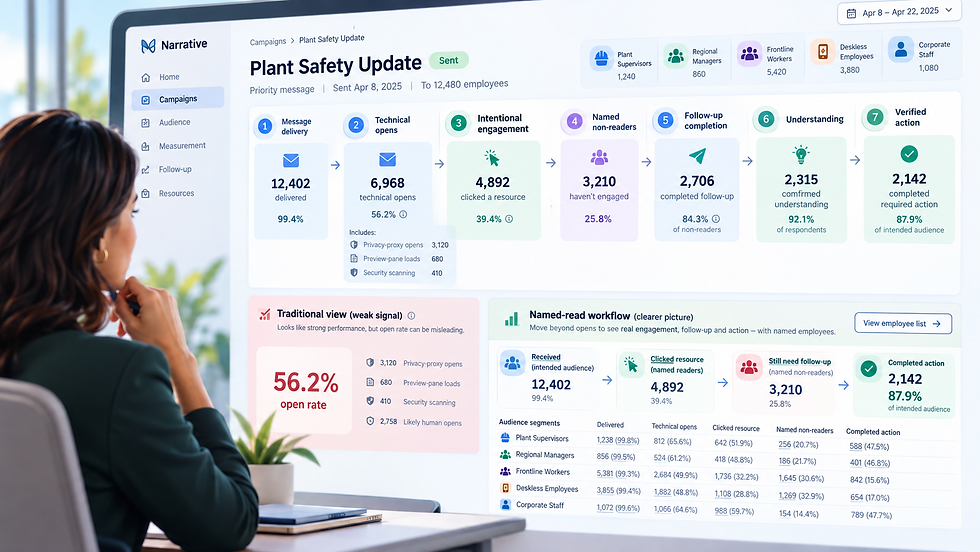
Apple's Mail Privacy Protection downloads remote content in the background as soon as a message arrives, so a tracking pixel can fire before anyone looks. In broad email-marketing data, Validity's State of Email in 2024 report found that 70% of all opens were generated by Apple's privacy proxy, and that average open rates rose from 25.5% to 65.1% after the change. Validity measured marketing email, and the same mechanism applies to any employee reading on Apple Mail.
The better expo question is whether the platform filters machine opens, and whether the rep can show you the number with and without them, side by side. Native read receipts won't rescue the metric either. Microsoft's own Outlook guidance says recipients can decline to send them and there is no way to force one.
Questions to ask internal communications vendors about read data
This is the part of the demo worth slowing down for. The questions below are practitioner guidance on what to probe and make no claim about how any particular platform works.
Start with the definition. Ask what single event marks a read and what threshold sits behind it, whether that is time spent in the message, scroll depth, a click, or an explicit acknowledgment. A vendor that can't name the event is reporting something, and you don't yet know what. Then ask to see reads per named employee and per cohort, by location or manager. A percentage is a summary for leadership. The named list is what an IC team works from when a policy change has to land with a specific group.
Next, push on channels that have no pixel at all. Ask how a read is recorded in Teams or Slack, in a mobile app, on the intranet, by SMS, or on digital signage, and whether the platform de-duplicates a read on one channel against another so the same person isn't counted twice. Multichannel reach numbers often look strongest where read evidence is thinnest.
Finally, make it concrete. Request a named list of non-readers exported right there in the demo, on sample data. Then ask whether "every employee" includes contractors and staff with no email address. A rep confident in the read data will be happy to show you, and hesitation is itself an answer.
What an analyst badge tells you
Badges are the other thing every booth wears. A quadrant placement is an analyst firm's judgment of a vendor against its market, which helps when you are shortlisting a vendor that will still be around in three years. Nothing in it measures whether one named employee at your company read your last message.
Gartner says as much in the disclaimer it requires whenever a vendor announces a placement in its Magic Quadrant research. The firm states that it does not endorse any vendor and does not advise technology users to select only those vendors with the highest ratings. The same disclaimer describes its research as the opinions of Gartner's research organization. When a pitch leans on placement, ask to see read data instead.
Run the same questions back at the office
Take the checklist home and run it against your current platform on your next priority send. Compare delivered counts against headcount and pull opens with machine opens filtered out. Then try to produce the named non-readers in the cohort that mattered most. If the tool you own today can't answer those, that gap is the finding to bring into your next budget conversation, whether or not you buy anything in Redmond.
Every booth on the floor will be able to reach your employees. The one worth your time is the one that can tell you, by name, who read it.


Comments