
You Sent the Memo. So What?

The send confirmation lands, the read numbers look healthy, and a week later the benefits enrollment count has not moved. If you have run a priority campaign, you know that week, when your dashboard says one thing and the system that owns the outcome says another.
The goalpost for internal comms measurement has moved twice in a few years, from reached to read and now to acted, and most teams still report on the first two while leadership asks about the third.
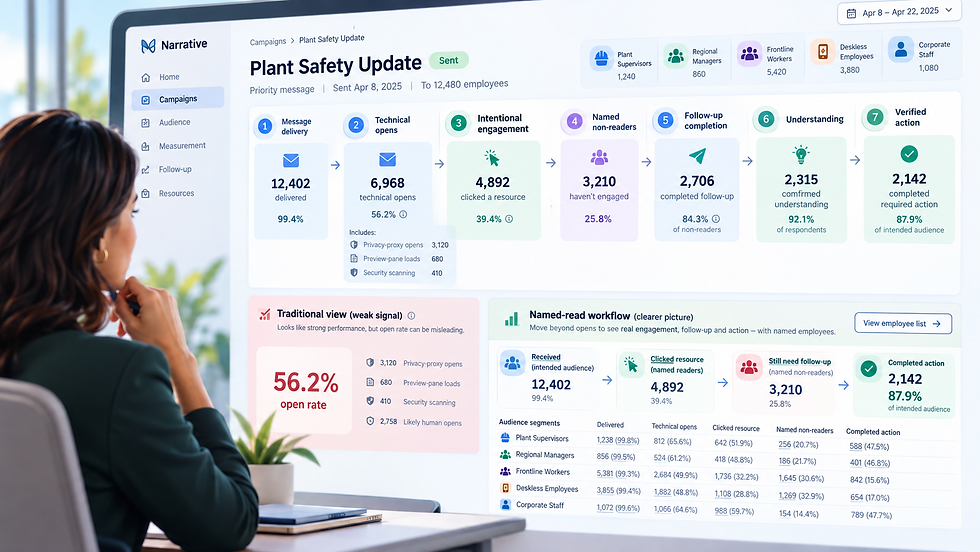
A read is the earliest signal that a named employee had the chance to act, which makes it the only leading indicator of action you can put a name against before the outcome lands in someone else's system. It is no proof of behavior change, and reporting it as though it were is how IC teams lose the room. The work is measuring reads against the specific action you wanted, then treating the gap between the two as a diagnostic.
How to measure behavior change in internal communications
Practitioner Johnna Muscente, speaking to Ragan, frames IC measurement as four questions. Reach asks whether the message got to people, and engagement asks whether they did anything with it beyond opening it. Understanding asks whether they took away what you intended. Behavior asks the question the business cares about, whether anything changed.
Most programs never climb past the first two rungs. The Gallagher 2026 Employee Communications Report, as Ragan reported, found that 70% of comms teams primarily measure output metrics like page views or click-throughs. Only 16% measure outcomes such as employee sentiment, and 12% track how their work ties into the larger activities of the business. A Ragan practitioner roundtable asked the same thing in sharper terms, whether click and open rates say anything about impact, or whether impact is about behavior change and business results.
If you have already separated a genuine read from an inflated open, you have the raw material for the next rung. The question is what that read signal predicts.
Read is the leading indicator you can use
Behavior data arrives late, and it arrives in someone else's system. Enrollment sits with HR and training completions sit with L&D, and in most programs the number reaches you as an aggregate weeks after the deadline passed. Read data arrives within hours, and it arrives per person.
That timing difference is the whole case for read. An employee who never took the message in will not act on it, so a read is a necessary precursor to action even though it falls well short of sufficient. It is the earliest signal you can intervene on while there is still room to change the result. The limit sits one step upstream. A read predicts nothing when the writer never named an action, and that is where most campaigns break.
Define the action before you write
Every priority send should carry one observable behavior, a submitted enrollment form or a shift swap made in the new scheduling tool. If the writer cannot name the behavior, the reader cannot do it. Gallup found that fewer than half of the employees it surveyed, 47%, strongly agree they know what is expected of them at work. That is with a job description behind the expectation. A single email carries far less.
Muscente's planning test applies here. Start from what each audience needs to do with the message, and decide in advance what you will do with the metrics you get back. A measurement you have no plan to act on is reporting with extra steps.
Pair the send with the behavior, then split the audience
Once you have paired the send with the behavior, the analysis is one join, the named read list from your comms platform next to the completion list from the owning system. Keep it that simple. The value sits in the three groups that fall out.
Read and acted
These employees are done. Count them, then leave them alone, because a reminder about something an employee already finished costs you credibility on the next send.
Read but did not act
This is the most useful of the three groups, and it is probably not a comms problem. As Muscente puts it in the same Ragan piece, when employees understand the message but still are not acting, the cause may sit outside communications, in an operational barrier. The form breaks on mobile, or the manager never released time for the training. Route it to whoever owns the process or the tool. Leadership rarely gets this kind of finding from IC, and handing it over changes what the function is for.
Did not read
This one is the comms problem, and it is yours. Channel and timing are in your control, and the next send belongs to this group.
Follow up with non-readers first
Sequence the second wave. Non-readers in the must-act cohort get a shorter message on a different channel, or a direct nudge from their manager, because repeating the same email to people who ignored it the first time rarely changes the result. Readers who did not act get the barrier fixed. Re-check both lists a few days before the deadline, while there is still room to respond.
Then report the whole thing in one sentence. "X of Y read and Z acted; the non-readers got a follow-up in Teams, and the mobile form that stopped the readers is now with the HRIS owner." That sentence answers what a slide of open rates never will, and it tells leadership where the next hour of effort should go.
Sending the memo proves you shipped. The read tells you who had the chance to act, and the completion list tells you whether it mattered. Tie both to one named behavior, and "so what?" has an answer.


Comments